As published on London Unattached, 15th August 2024
Now a fairytale destination that should be on everyone’s bucket lists, Bruges was once a bustling centre of trade, and the home of painter Jan Van Eyck. As you wander through the streets, it is easy to imagine the city as it was in Van Eyck’s time, in the 15th century. Here are some of the attractions that bring alive the Golden Age of Bruges and the old haunts of the famous painter.
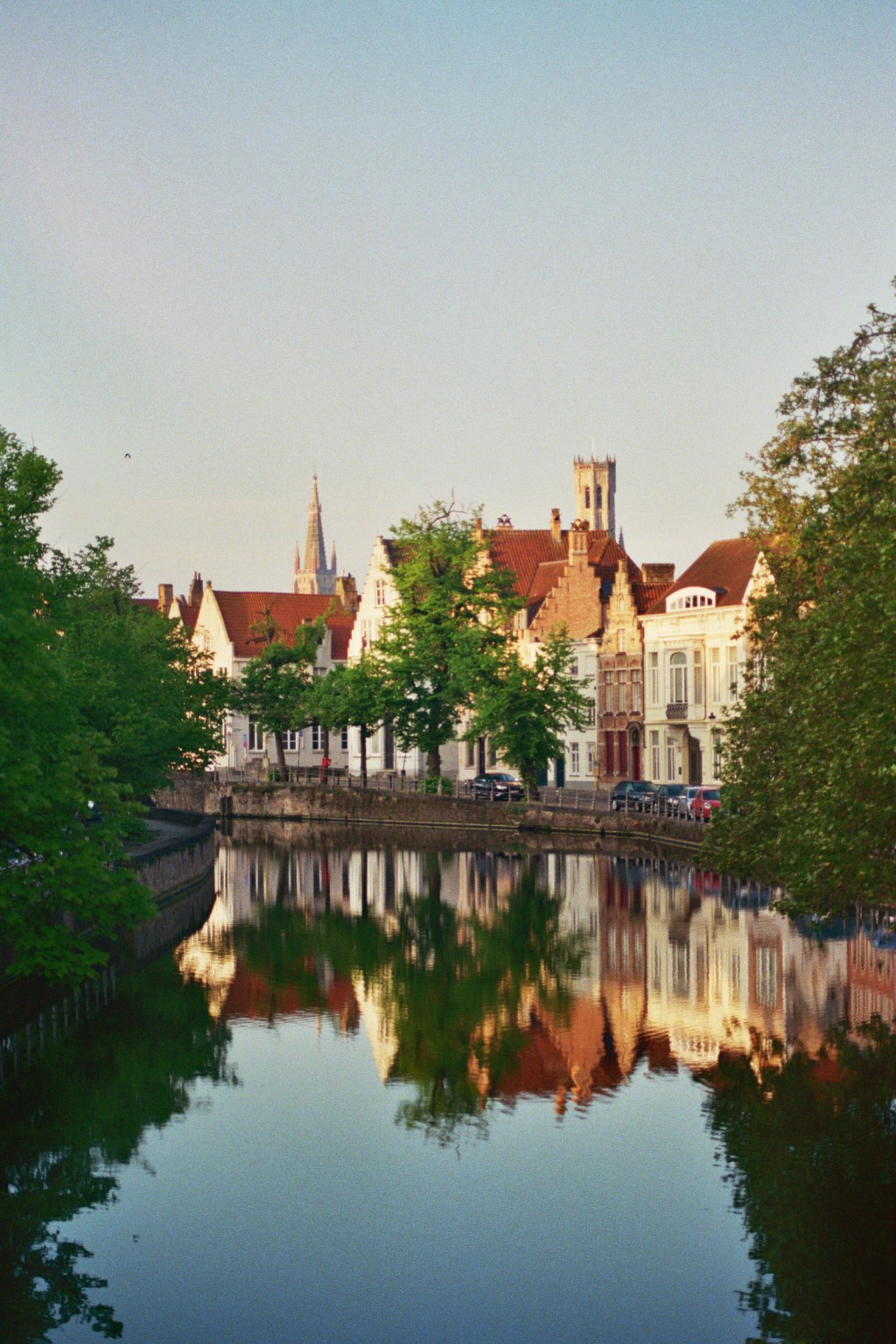
It is hours still until the first boats will throng through these canals, and so Bruges is wrapped in silver ribbons, criss-crossed in smooth, unshattered mirrors. Peering in to see their faces are all the gabled houses lining the banks, dressed in plum, cherry and burnt brick. Early morning sun, fresh and clean, pours itself into their red-framed windows.
A woman cycles past.
Besides her and me, the streets are empty.
I am walking along the Spiegelrei and Langerei, where six hundred years ago, ships and barges would have unloaded their precious cargo from all over the world. It is here, in this city, that the world’s first stock exchange was established, and in its Golden Age, from the 14th to 15th centuries, it teemed with life and trade. Its inhabitants numbered twice as many then as now, testament to the city’s historic status as a global hub of trade and commerce.
When, at the end of the 15th century, the Burgundian court left Bruges and the canal connecting the city to the sea silted up, its glory faded. For many centuries it was forgotten, the progress of the Industrial Revolution largely skirting its walls – it was a city frozen in time, preserved by virtue of its poverty. Then in 1838, Bruges was connected to the rail network. Britons visiting the site of the Battle of Waterloo stopped over in Bruges and gradually the city became a new tourist destination. Georges Rodenbach’s novel Bruges la Morte (1892) inspired French visitors as well, and over the years, the reconstruction and preservation of old buildings was funded, creating the uniform Gothic aesthetic now prevalent throughout the city centre.
I reach the end of Spiegelrei, where a large statue of Jan Van Eyck, the Northern Renaissance painter, towers over the eponymously named square. Born in circa 1380-1390, Van Eyck spent many years establishing himself in The Hague before moving to Bruges. Here he was appointed court painter and diplomat for Philip the Good, Duke of Burgundy, in c.1425. During his time in Bruges, Van Eyck shot to fame, pioneering innovative techniques in the use of oil paint and gaining renown for the realistic portrayals of his sitters. The level of detail in his paintings, such as the texture of luxurious fabrics and the gleam of jewels, may have been directly influenced by the vast array of exotic wares brought into Bruges by foreign traders, which Van Eyck would have seen every day at the docks.
In fact, just a few streets down from the Spiegelrei is where his house once stood, at no.10 Gouden-Handrei. Though it is now a modern house, it is not hard to imagine what it must have been like for Van Eyck to wander these streets nearly six hundred years ago. Perhaps it is the magic of the morning light, but I can see the wooden barges and the richly adorned merchants, can hear the clamour of the markets and the horses – in fact, today, you can go on a horse-drawn carriage ride through the city to really get a feel for medieval Bruges.
In this same neighbourhood, which used to be the artist’s quarter and later also home to fellow painter Hans Memling, there are two streets where you can still see the original wooden facades that would have fronted most houses in the 15th century. In Genthof and Kortewinkel, the last two remaining houses stand, their dark wooden facades ghosts of centuries past. In the 16th century, when wooden houses were banned due to fire risk, these two houses miraculously survived, still whispering of a time before stone.
As I make my way towards the centre, the city begins, slowly, to wake. A rubbish truck trundles past. A fellow tourist saunters along with his camera at the ready. The first cafés are opening, waiters carrying out the tables and washing down the windows.
Markt Square, with its iconic Belfry, was a centre of trade in Van Eyck’s time. The belfry’s tower would have been slightly shorter but looked much the same. Underneath it, in the City Halls, three hundred and eighty or more stalls would have sold their wares, ranging from the famous Flemish cloth and tapestries to knives and spices. When the City Halls became too small, a new building was built to the left of the Belfry, where the Provincial Court now stands; the famous Water Halls. Van Eyck would have witnessed this impressive structure, which used to dominate the square, stretching for one hundred metres over the Kraanrei river, serving as a station for merchants to load and unload their produce. In Hof Arents, near the Gruuthuuse Museum, the last remnants of the Water Halls are displayed. Today the river still flows, hidden, underneath the Provincial Court.
Next to the Provincial Court, the Historium museum offers a tour through themed rooms of medieval Bruges, with a virtual apprentice of Van Eyck guiding you through the streets and past ancient landmarks such as the lost Water Halls and St Donatian’s Cathedral.
St Donatian’s Cathedral was the largest cathedral in Bruges, looming over Burg Square just around the corner from Markt Square. It stood opposite the manor of the Brugse Vrije (Franc of Bruges), the City Hall and the old Civil Registry, all impressive buildings elaborately decorated with gold. Van Eyck, upon his death in July 1441, was buried in St Donatian’s Cathedral, a high honour and testimony of his respected status in the community. Unfortunately, following the aftermath of the French Revolution, along with the Water Halls, the cathedral was raised to the ground in 1799 – a park and some plane trees now stand in its place, inlaid bricks marking the extent of its former glory. Van Eyck’s grave, alas, was lost.
My next destination is the Groeninge Museum, which opens soon for the day. Here are exhibited some beautiful paintings by the so-called Flemish Primitives, Van Eyck perhaps the most famous among these – his notable work, The Madonna with Canon van der Paele, is an unmissable example of his skill and astounding eye for detail.
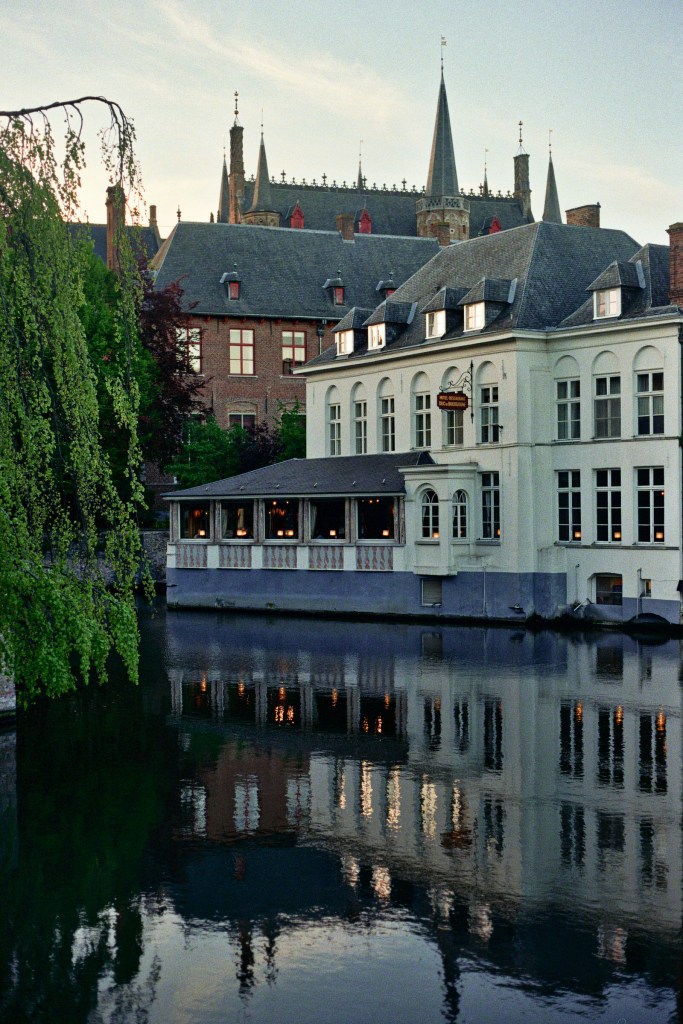
To get there, I walk through a narrow passage leading off from Burg Square, over a bridge and across the old Fish Market Square. Rounding a corner, the fairytale view of the Rosary Quay greets me, mercifully empty of tourists this early in the morning. Two canals converge on the corner, a willow tree drooping its branches in the water. Red brick buildings line the banks, and behind them rises the spire of the Belfry. Just a little further down the canal I can see the entrance to the Groeninge Museum. Could Van Eyck ever have dreamed of his paintings drawing thousands of visitors, centuries on? Would he have walked these cobblestones, admiring the view? Would the view have been the same? The trees were different, and the boats, and the rosaries Van Eyck may have bought here are no longer sold. His grave has vanished, as have the Water Halls and the magnificent dome of St Donatian’s Cathedral. But there is a magic still that winds its way through these narrow streets and silver canals, when the day is fresh and the city quiet. When you are alone with the buildings, they tell their stories. They invite you to step closer, to lean in, to listen – once upon a time…
 Maria Stallmann
Leave a comment