[As published in Birdwatching Magazine’s January 2026 print edition]
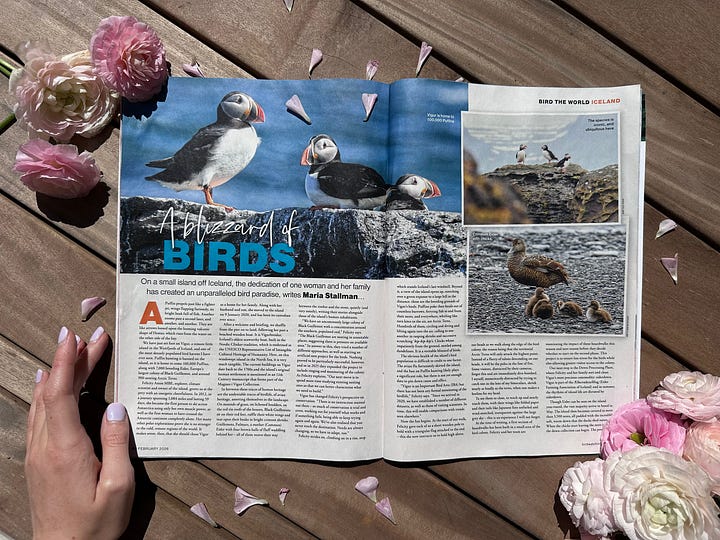
On a small island off Iceland, the dedication of one woman and her family has created an unparalleled bird paradise, writes Maria Stallmann…
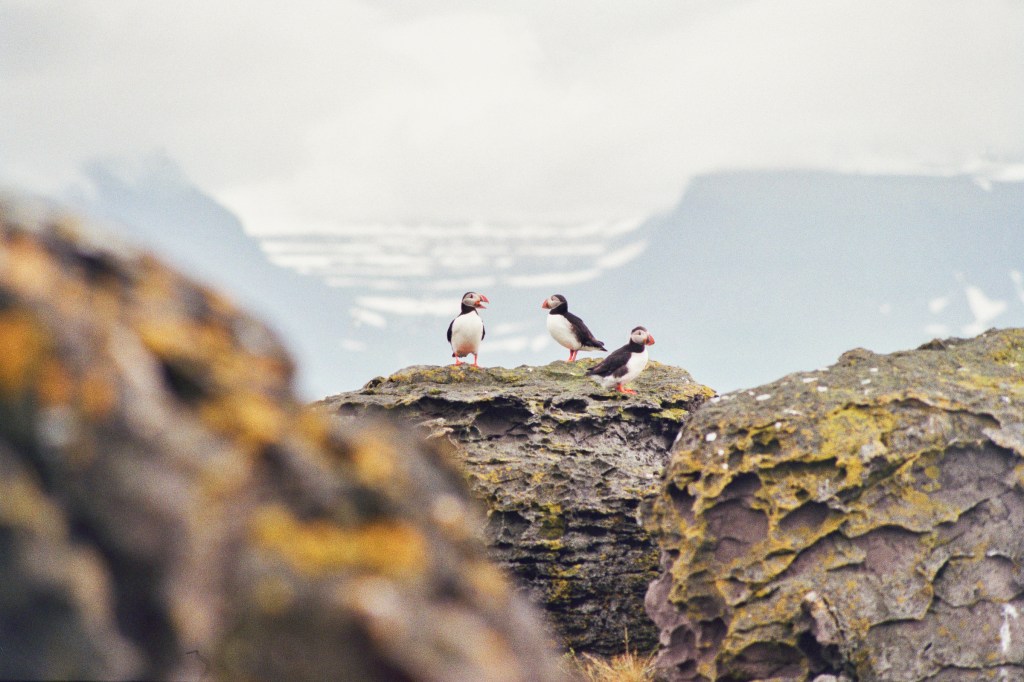
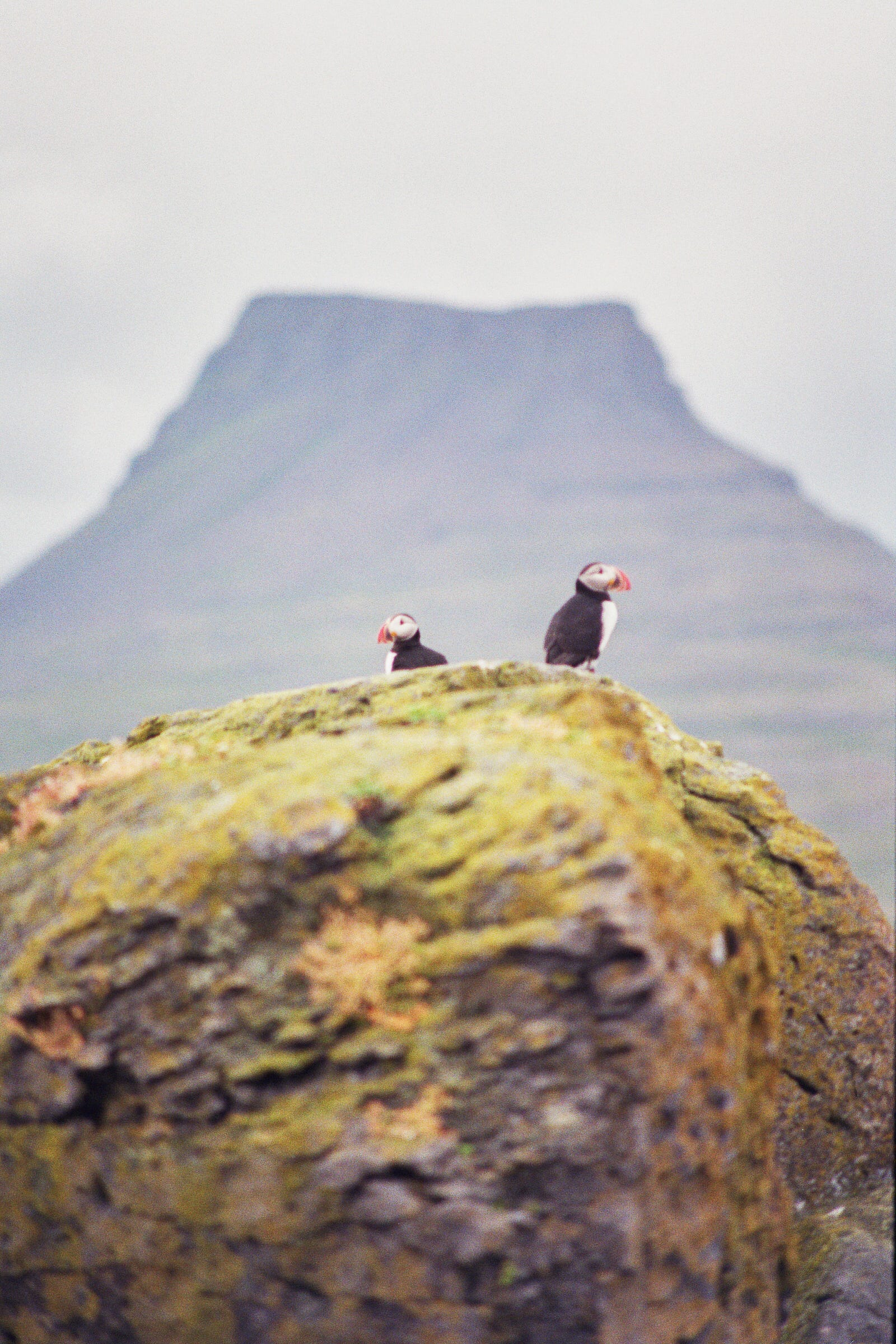
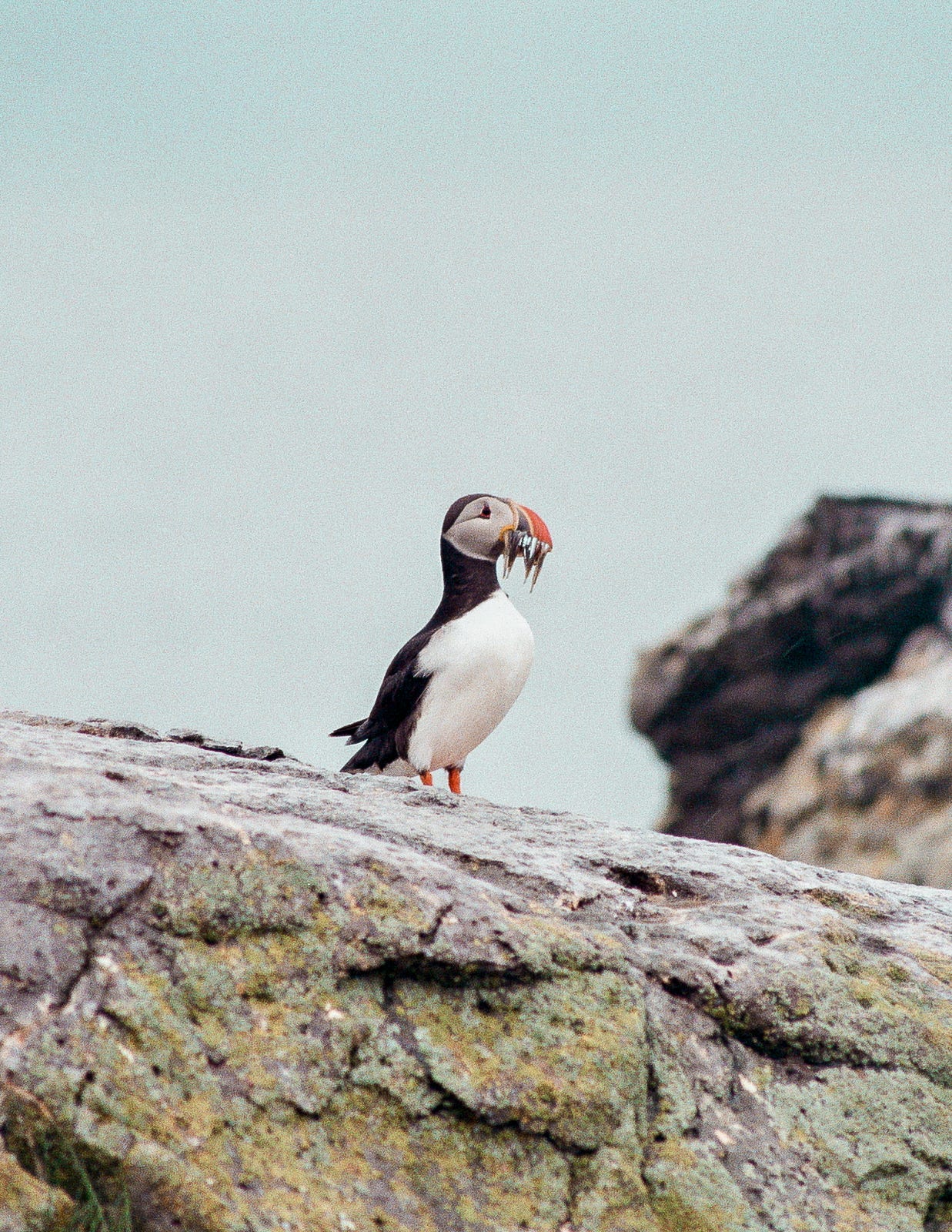
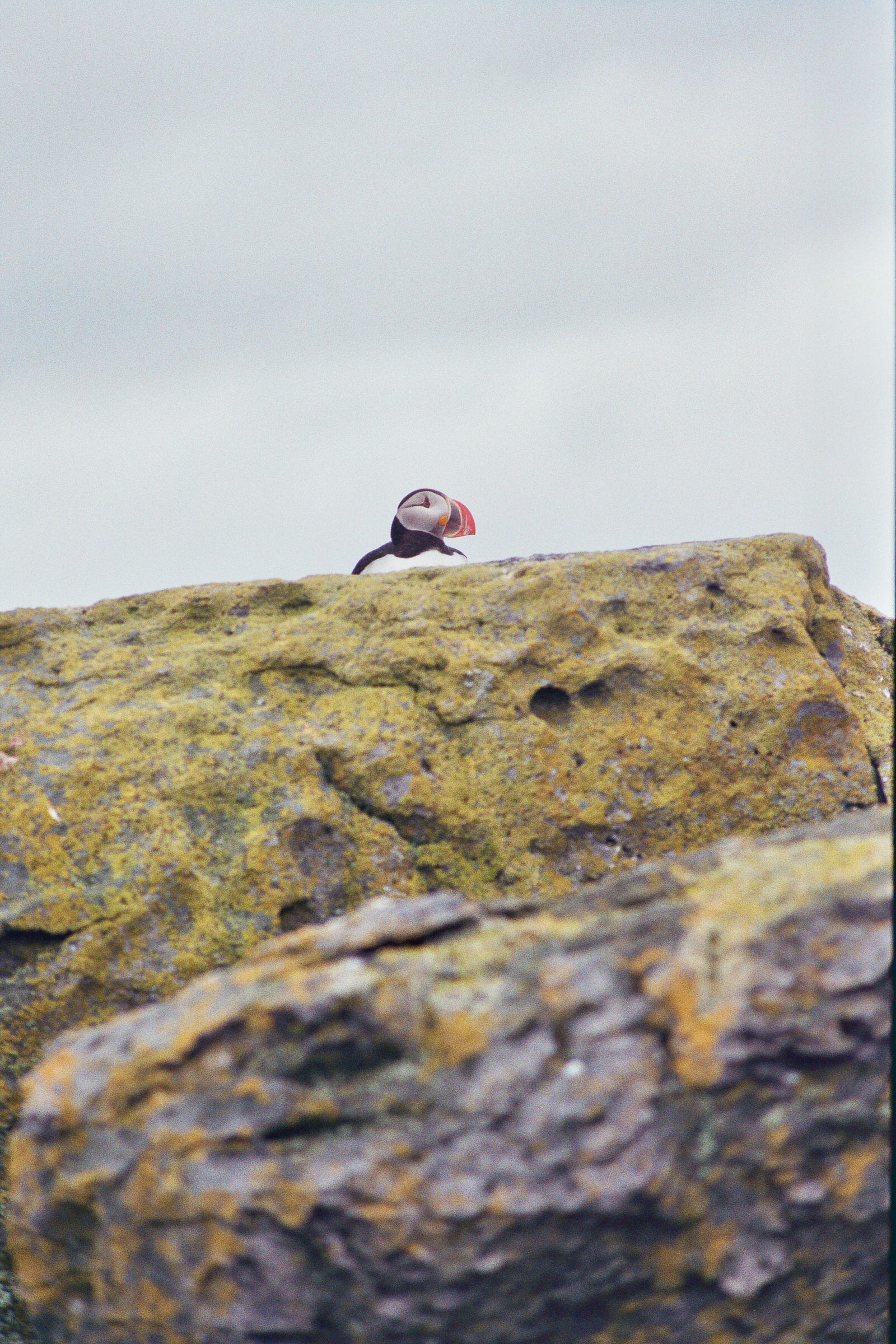
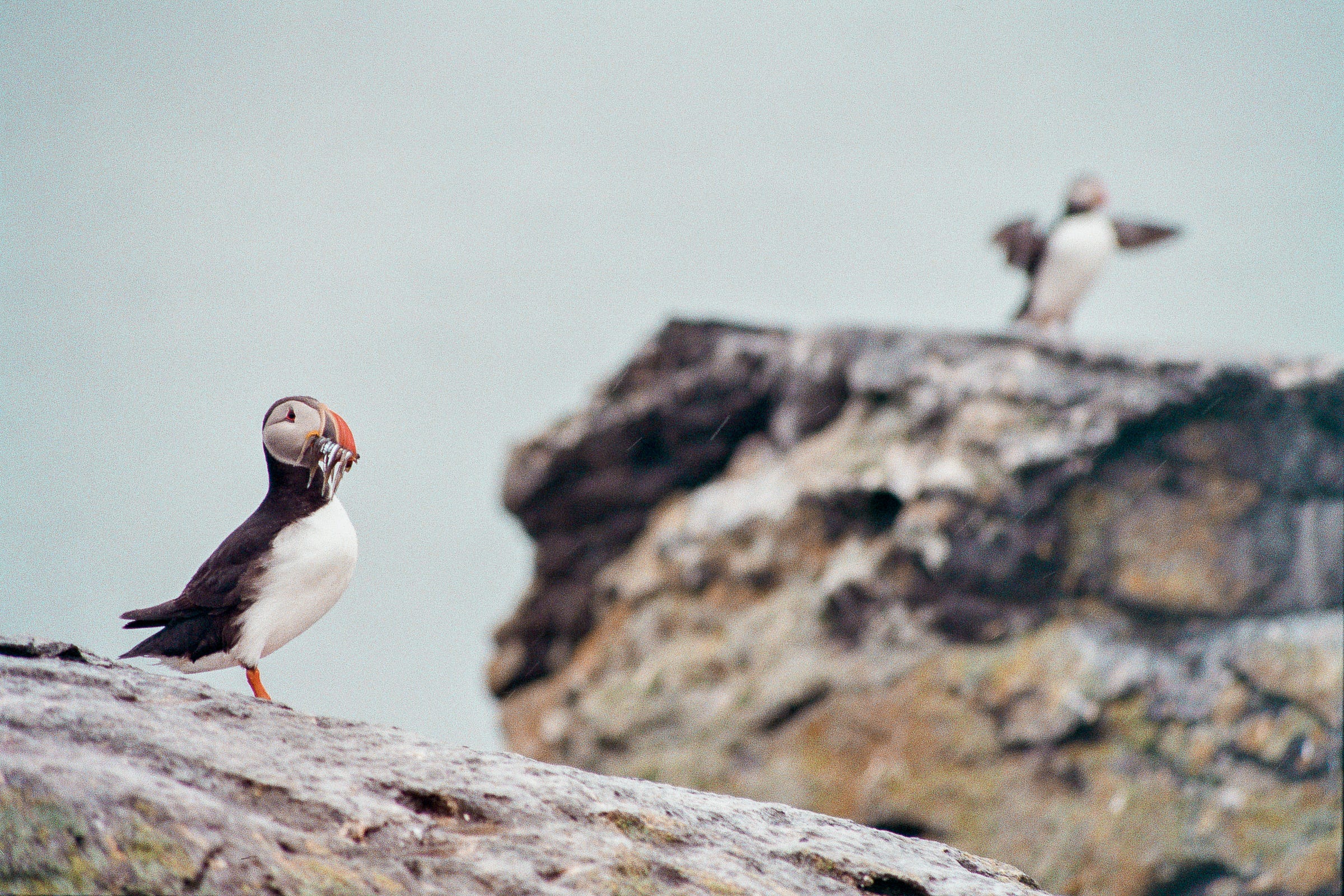
A Puffin propels past like a fighter jet, wings flapping furiously, its bright beak full of fish. Another zooms past a second later, and another, and another. They are like arrows loosed upon the looming volcanic shape of Hestur, which rises from the water on the other side of the bay.
We have just set foot on Vigur, a remote little island in the Westfjords of Iceland, and one of the most densely populated bird havens I have ever seen. Puffin hunting is banned on the island, so it is home to some 100,000 Puffins, along with 7,000 breeding Eider, Europe’s largest colony of Black Guillemot, and around 900 nesting Arctic Terns.
Felicity Aston MBE, explorer, climate scientist and owner of the island, greets us at the jetty with an energetic cheerfulness. In 2012, in a journey spanning 1,084 miles and lasting 59 days, she became the first person to ski across Antarctica using only her own muscle power, as well as the first woman to have crossed the Antarctic continent completely alone. Her many other polar explorations prove she is no stranger to the cold, remote regions of the world. It makes sense, then, that she should chose Vigur as a home for her family. Along with her husband and son, she moved to the island on 9 January 2020, and has been its custodian ever since.
After a welcome and briefing, we shuffle from the pier on to land, following her past a beached wooden boat. It is Vigurbreidur, Iceland’s oldest seaworthy boat, built in the Nordic Clinker tradition, which is enshrined in the UNESCO Representative List of Intangible Cultural Heritage of Humanity. Here, on this windswept island in the North Sea, it is very much tangible. The current buildings on Vigur date back to the 1700s and the island’s original human settlement is mentioned in an 11th Century manuscript that forms part of the Magnus í Vigur Collection.
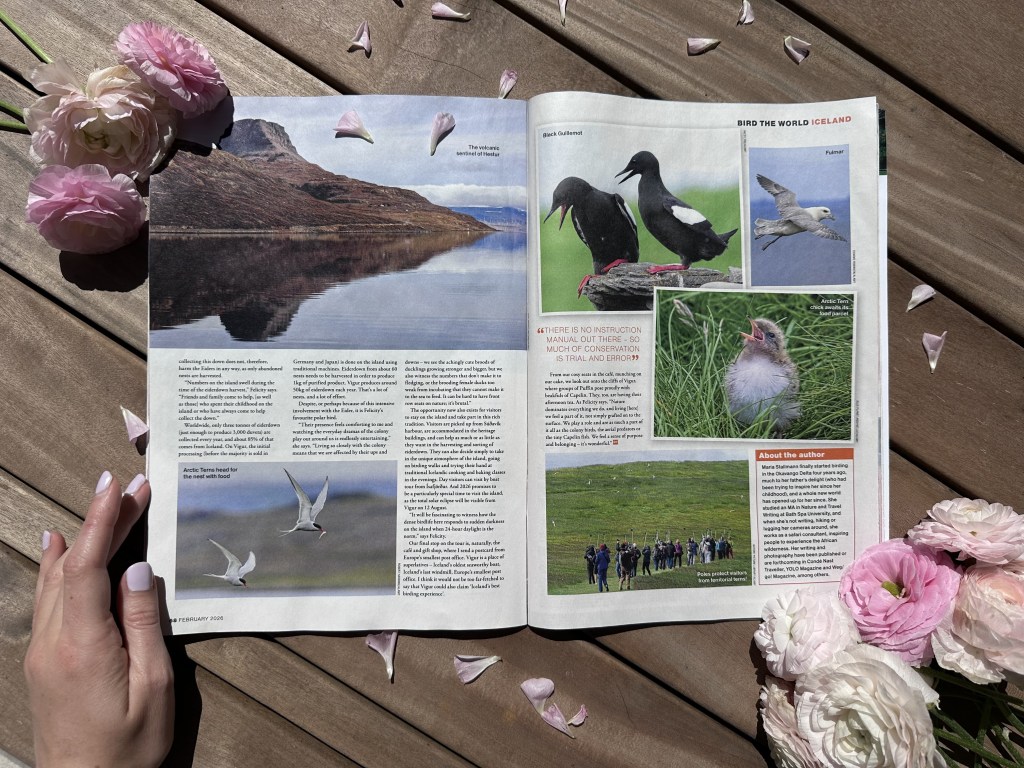
In between these traces of human heritage are the undeniable traces of birdlife, of avian heritage, asserting themselves in the landscape. On mounds of grass, on lichened boulders, on the red tin roofs of the houses, Black Guillemots sit on their red feet, ruffle their white wings and tear open their beaks in bright crimson shrieks. Guillemots, Fulmars, a mother (Common) Eider with four brown balls of fluff waddling behind her — all of them weave their way between the timber and the stone, quietly (and very noisily) writing their stories alongside those of the island’s human inhabitants.
“We have an uncommonly large colony of Black Guillemot with a concentration around the southern, populated end,” Felicity says. “The Black Guillemot are nesting in unsuitable places, suggesting there is pressure on available sites.” In answer to this, they tried a number of different approaches, as well as starting an artificial nest project for the birds. Nothing proved to be particularly successful, however, and so in 2025 they expanded the project to include ringing and monitoring of the colony. As Felicity explains, “Our next move is to spend more time studying existing nesting sites so that we can better characterise what we need to build.”
Vigur has changed Felicity’s perspective on conservation. “There is no instruction manual out there — so much of conservation is trial and error, working out for yourself what works and if something fails, being able to keep trying again and again. We’ve also realised that you never reach the destination. Needs are always changing and so we have to adapt, too.”
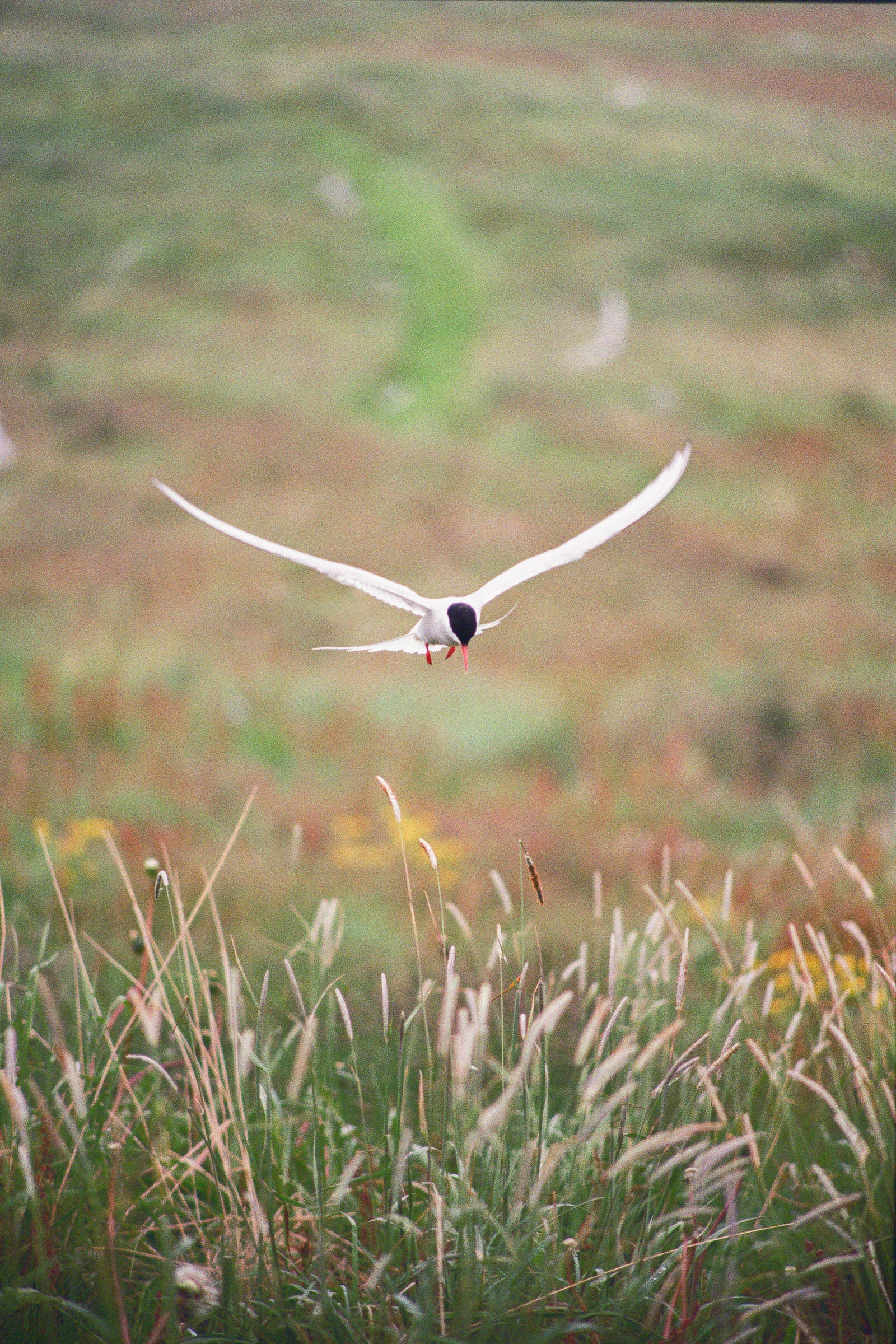
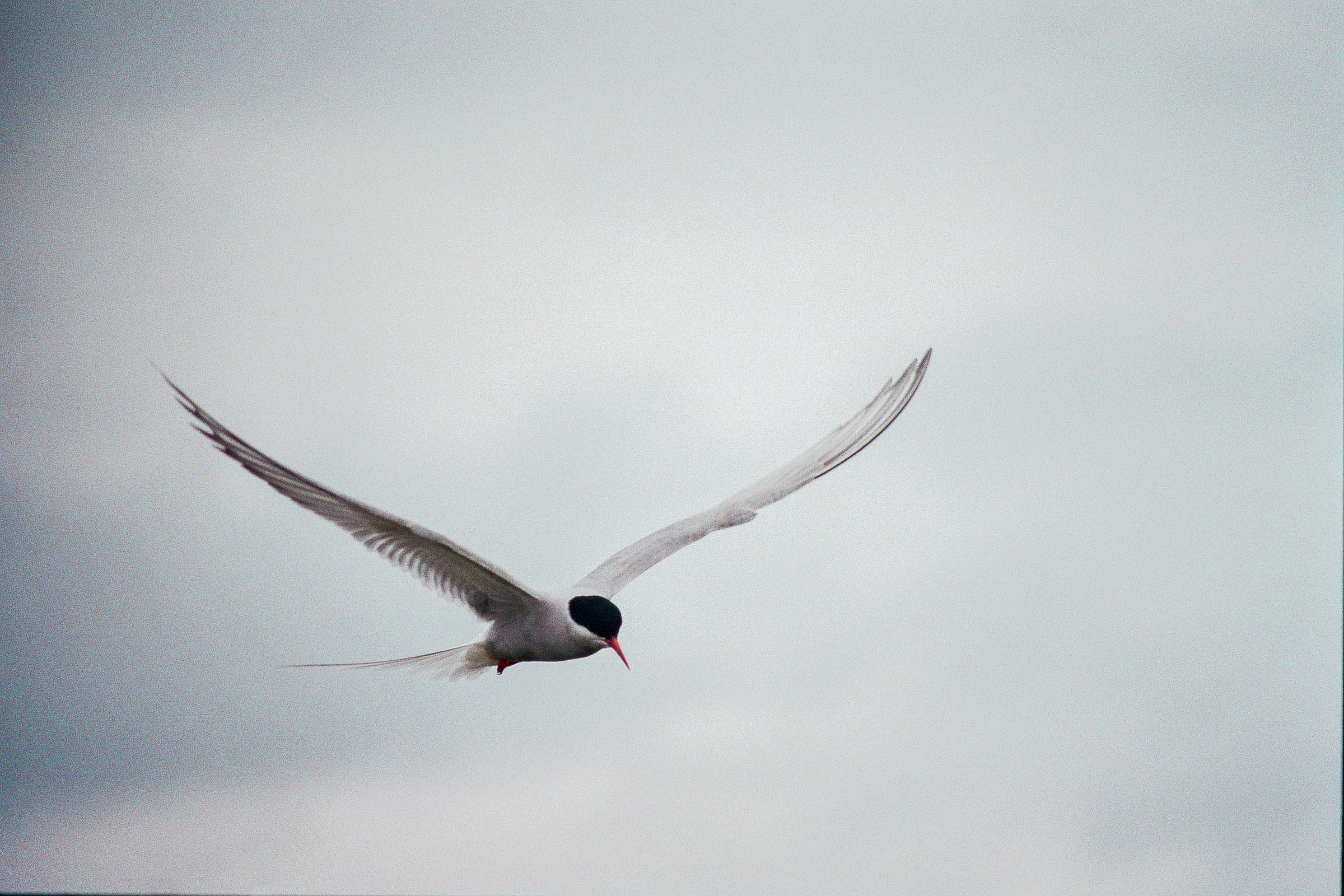
Felicity strides on, climbing onto a rise, atop which stands Iceland’s last windmill. Beyond it a view of the island opens up, stretching over a green expanse to a large hill in the distance: these are the breeding grounds of Vigur’s birds. Puffins poke their heads out of countless burrows, ferrying fish to and from their nests, and everywhere, whirling like torn kites in the air, are Arctic Terns. Hundreds of them, circling and diving and lifting again into the air, calling to one another in rasping shrieks and successive scratching ‘kip-kip-kip’s. Chicks whine impatiently from the ground, nestled among dandelions. It is a veritable blizzard of birds.
The obvious health of the island’s bird population is difficult to credit to one factor. The avian flu fortunately skirted the island, and the ban on Puffin hunting likely plays a significant role, but there is not yet enough data to pin down cause and effect.
“Vigur is an Important Bird Area (IBA) but there has not been any formal monitoring of the birdlife,” Felicity says. “Since we arrived in 2020, we have established a number of different datasets, as well as those of visiting scientists. In time this will enable comparisons with trends seen elsewhere.”
Now the fun begins. At the start of our walk, Felicity gave each of us a short wooden pole to hold with a triangular flag attached to the end — this she now instructs us to hold high above our heads as we walk along the edge of the bird colony, the reason being that the territorial Arctic Terns will only attack the highest point. Instead of a flurry of talons descending on our heads, it will be the poles in the line of fire. Some visitors, distracted by their cameras, forget this and are immediately dive-bombed. I myself, momentarily distracted by trying to catch one in the lens of my binoculars, shriek nearly as loudly as the Terns, when one makes a beeline for my head.
To see them so close, to reach up and nearly touch them, with their wings like folded paper and their tails like Japanese fans unfurled and wind-snatched, transparent against the large grey sky — this is an experience I will not forget.
At the time of writing, a first section of boardwalks has been built in a small area of the bird colony. Felicity and her team are monitoring the impact of these boardwalks this season and next season before they decide whether to start on the second phase. This project is to ensure less stress for the birds while also allowing greater visitor access to the colony.
Our next stop is the Down Processing Plant, where Felicity and her family sort and clean Vigur’s most precious commodity: eiderdown. Vigur is part of the Æðarrœktarfélag (Eider Farming Association of Iceland) and in summer, the rhythms of island life are dictated by eiderdown.
Though Eider can be seen on the island year-round, the vast majority arrive to breed in May. The island then becomes covered in more than 3,500 nests, all padded with the incredibly soft, warm down that the ducks shed naturally. When the chicks start leaving the nests in June, the down collection can begin. The process of collecting this down does not, therefore, harm the Eiders in any way, as only abandoned nests are harvested.
“Numbers on the island swell during the time of the eiderdown harvest,” Felicity says. “Friends and family come to help, [as well as those] who spent their childhood on the island or who have always come to help collect the down.”
Worldwide, only three tonnes of eiderdown (just enough to produce 3,000 duvets) are collected every year, and around 85% of that comes from Iceland. On Vigur, the initial processing (before the majority is sold in Germany and Japan) is done on the island using traditional machines. Eiderdown from around 60 nests needs to be harvested in order to produce 1kg of purified product. Vigur produces around 50kg of eiderdown each year. That’s a lot of nests, and a lot of effort.
Despite, or perhaps because of this intensive involvement with the Eider, it is Felicity’s favourite polar bird.
“Their presence feels comforting to me and watching the everyday dramas of the colony play out around us is endlessly entertaining,” she says. “Living so closely with the colony means that we are affected by their ups and downs — we see the achingly cute broods of ducklings growing stronger and bigger, but we also witness the numbers that don’t make it to fledging, or the brooding female ducks too weak from incubating that they cannot make it to the sea to feed. It can be hard to have front row seats on nature; it’s brutal.”
The opportunity now also exists for visitors to stay on the island and take part in this rich tradition. Visitors are picked up from Súðavík harbour, are accommodated in the heritage buildings, and can help as much or as little as they want in the harvesting and sorting of eiderdown. They can also decide simply to take in the unique atmosphere of the island, going on birding walks and trying their hand at traditional Icelandic cooking and baking classes in the evenings. Day visitors can visit by boat tour from Ísafjörður. And 2026 promises to be a particularly special time to visit the island, as the total solar eclipse will be visible from Vigur on 12 August.
“It will be fascinating to witness how the dense birdlife here responds to sudden darkness on the island when 24-hour daylight is the norm,” says Felicity.
Our final stop on the tour is, naturally, the café and gift shop, where I send a postcard from Europe’s smallest post office. Vigur is a place of superlatives — Iceland’s oldest seaworthy boat, Iceland’s last windmill, Europe’s smallest post office. I think it would not be too far-fetched to say that Vigur could also claim ‘Iceland’s best birding experience’.
From our cosy seats in the café, munching on our cake, we look out onto the cliffs of Vigur, where groups of Puffin pose proudly with beakfuls of Capelin. They, too, are having their afternoon tea. As Felicity says, “Nature dominates everything we do, and living [here] we feel a part of it, not simply grafted on to the surface. We play a role and are as much a part of it all as the colony birds, the aerial predators or the tiny Capelin fish. We feel a sense of purpose and belonging — it’s wonderful.”
On a small island off Iceland, the dedication of one woman and her family has created an unparalleled bird paradise.
A Puffin propels past like a fighter jet, wings flapping furiously, its bright beak full of fish. Another zooms past a second later, and another, and another. They are like arrows loosed upon the looming volcanic shape of Hestur, which rises from the water on the other side of the bay.
We have just set foot on Vigur, a remote little island in the Westfjords of Iceland, and one of the most densely populated bird havens I have ever seen. Puffin hunting is banned on the island, so it is home to some 100,000 Puffins, along with 7,000 breeding Eider, Europe’s largest colony of Black Guillemot, and around 900 nesting Arctic Terns.
Felicity Aston MBE, explorer, climate scientist and owner of the island, greets us at the jetty with an energetic cheerfulness. In 2012, in a journey spanning 1,084 miles and lasting 59 days, she became the first person to ski across Antarctica using only her own muscle power, as well as the first woman to have crossed the Antarctic continent completely alone. Her many other polar explorations prove she is no stranger to the cold, remote regions of the world. It makes sense, then, that she should chose Vigur as a home for her family. Along with her husband and son, she moved to the island on 9 January 2020, and has been its custodian ever since.
After a welcome and briefing, we shuffle from the pier on to land, following her past a beached wooden boat. It is Vigurbreidur, Iceland’s oldest seaworthy boat, built in the Nordic Clinker tradition, which is enshrined in the UNESCO Representative List of Intangible Cultural Heritage of Humanity. Here, on this windswept island in the North Sea, it is very much tangible. The current buildings on Vigur date back to the 1700s and the island’s original human settlement is mentioned in an 11th Century manuscript that forms part of the Magnus í Vigur Collection.
In between these traces of human heritage are the undeniable traces of birdlife, of avian heritage, asserting themselves in the landscape. On mounds of grass, on lichened boulders, on the red tin roofs of the houses, Black Guillemots sit on their red feet, ruffle their white wings and tear open their beaks in bright crimson shrieks. Guillemots, Fulmars, a mother (Common) Eider with four brown balls of fluff waddling behind her — all of them weave their way between the timber and the stone, quietly (and very noisily) writing their stories alongside those of the island’s human inhabitants.
“We have an uncommonly large colony of Black Guillemot with a concentration around the southern, populated end,” Felicity says. “The Black Guillemot are nesting in unsuitable places, suggesting there is pressure on available sites.” In answer to this, they tried a number of different approaches, as well as starting an artificial nest project for the birds. Nothing proved to be particularly successful, however, and so in 2025 they expanded the project to include ringing and monitoring of the colony. As Felicity explains, “Our next move is to spend more time studying existing nesting sites so that we can better characterise what we need to build.”
Vigur has changed Felicity’s perspective on conservation. “There is no instruction manual out there — so much of conservation is trial and error, working out for yourself what works and if something fails, being able to keep trying again and again. We’ve also realised that you never reach the destination. Needs are always changing and so we have to adapt, too.”
Felicity strides on, climbing onto a rise, atop which stands Iceland’s last windmill. Beyond it a view of the island opens up, stretching over a green expanse to a large hill in the distance: these are the breeding grounds of Vigur’s birds. Puffins poke their heads out of countless burrows, ferrying fish to and from their nests, and everywhere, whirling like torn kites in the air, are Arctic Terns. Hundreds of them, circling and diving and lifting again into the air, calling to one another in rasping shrieks and successive scratching ‘kip-kip-kip’s. Chicks whine impatiently from the ground, nestled among dandelions. It is a veritable blizzard of birds.
The obvious health of the island’s bird population is difficult to credit to one factor. The avian flu fortunately skirted the island, and the ban on Puffin hunting likely plays a significant role, but there is not yet enough data to pin down cause and effect.
“Vigur is an Important Bird Area (IBA) but there has not been any formal monitoring of the birdlife,” Felicity says. “Since we arrived in 2020, we have established a number of different datasets, as well as those of visiting scientists. In time this will enable comparisons with trends seen elsewhere.”
Now the fun begins. At the start of our walk, Felicity gave each of us a short wooden pole to hold with a triangular flag attached to the end — this she now instructs us to hold high above our heads as we walk along the edge of the bird colony, the reason being that the territorial Arctic Terns will only attack the highest point. Instead of a flurry of talons descending on our heads, it will be the poles in the line of fire. Some visitors, distracted by their cameras, forget this and are immediately dive-bombed. I myself, momentarily distracted by trying to catch one in the lens of my binoculars, shriek nearly as loudly as the Terns, when one makes a beeline for my head.
To see them so close, to reach up and nearly touch them, with their wings like folded paper and their tails like Japanese fans unfurled and wind-snatched, transparent against the large grey sky — this is an experience I will not forget.
At the time of writing, a first section of boardwalks has been built in a small area of the bird colony. Felicity and her team are monitoring the impact of these boardwalks this season and next season before they decide whether to start on the second phase. This project is to ensure less stress for the birds while also allowing greater visitor access to the colony.
Our next stop is the Down Processing Plant, where Felicity and her family sort and clean Vigur’s most precious commodity: eiderdown. Vigur is part of the Æðarrœktarfélag (Eider Farming Association of Iceland) and in summer, the rhythms of island life are dictated by eiderdown.
Though Eider can be seen on the island year-round, the vast majority arrive to breed in May. The island then becomes covered in more than 3,500 nests, all padded with the incredibly soft, warm down that the ducks shed naturally. When the chicks start leaving the nests in June, the down collection can begin. The process of collecting this down does not, therefore, harm the Eiders in any way, as only abandoned nests are harvested.
“Numbers on the island swell during the time of the eiderdown harvest,” Felicity says. “Friends and family come to help, [as well as those] who spent their childhood on the island or who have always come to help collect the down.”
Worldwide, only three tonnes of eiderdown (just enough to produce 3,000 duvets) are collected every year, and around 85% of that comes from Iceland. On Vigur, the initial processing (before the majority is sold in Germany and Japan) is done on the island using traditional machines. Eiderdown from around 60 nests needs to be harvested in order to produce 1kg of purified product. Vigur produces around 50kg of eiderdown each year. That’s a lot of nests, and a lot of effort.
Despite, or perhaps because of this intensive involvement with the Eider, it is Felicity’s favourite polar bird.
“Their presence feels comforting to me and watching the everyday dramas of the colony play out around us is endlessly entertaining,” she says. “Living so closely with the colony means that we are affected by their ups and downs — we see the achingly cute broods of ducklings growing stronger and bigger, but we also witness the numbers that don’t make it to fledging, or the brooding female ducks too weak from incubating that they cannot make it to the sea to feed. It can be hard to have front row seats on nature; it’s brutal.”
The opportunity now also exists for visitors to stay on the island and take part in this rich tradition. Visitors are picked up from Súðavík harbour, are accommodated in the heritage buildings, and can help as much or as little as they want in the harvesting and sorting of eiderdown. They can also decide simply to take in the unique atmosphere of the island, going on birding walks and trying their hand at traditional Icelandic cooking and baking classes in the evenings. Day visitors can visit by boat tour from Ísafjörður. And 2026 promises to be a particularly special time to visit the island, as the total solar eclipse will be visible from Vigur on 12 August.
“It will be fascinating to witness how the dense birdlife here responds to sudden darkness on the island when 24-hour daylight is the norm,” says Felicity.
Our final stop on the tour is, naturally, the café and gift shop, where I send a postcard from Europe’s smallest post office. Vigur is a place of superlatives — Iceland’s oldest seaworthy boat, Iceland’s last windmill, Europe’s smallest post office. I think it would not be too far-fetched to say that Vigur could also claim ‘Iceland’s best birding experience’.
From our cosy seats in the café, munching on our cake, we look out onto the cliffs of Vigur, where groups of Puffin pose proudly with beakfuls of Capelin. They, too, are having their afternoon tea. As Felicity says, “Nature dominates everything we do, and living [here] we feel a part of it, not simply grafted on to the surface. We play a role and are as much a part of it all as the colony birds, the aerial predators or the tiny Capelin fish. We feel a sense of purpose and belonging — it’s wonderful.”
 Maria Stallmann
Leave a comment